

A-system bayonet mixers
2 families, 12 variants
Square Bayonet Static Mixing Tubes
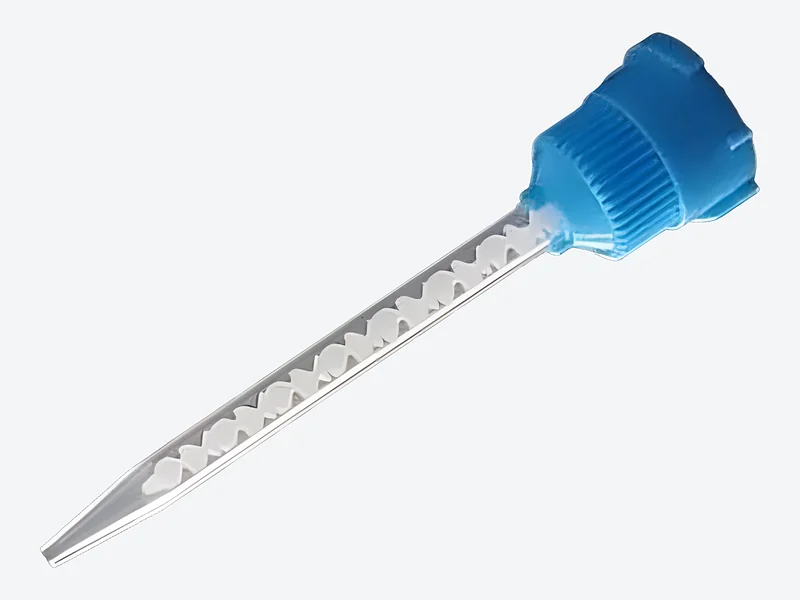
Square bayonet static mixing tubes blend two-part adhesives such as epoxies, polyurethanes and silicones as they leave a 50 ml A-system style cartridge. The twist-lock bayonet inlet seats on the cartridge, and mixed material exits through a round outlet.
Our range covers polypropylene housings from 7.3 to 12.9 mm OD with outlet bores of 2, 3 and 3.5 mm. Element counts are 8, 12, 16 and 24, giving overall lengths from 61.8 mm (2.43 in.) to 231 mm (9.09 in.). We supply every size in bulk.
| SKU | Length mm | Length in | ID mm | OD mm | Elements | Material | Hub / fitting |
|---|---|---|---|---|---|---|---|
| LS-DSP-004-408 | 61.8 | 2.438 | 2 | 7.3 | 8 | Polypropylene | Bayonet |
| LS-DSP-004-416 | 99 | 3.9 | 2 | 7.3 | 16 | Polypropylene | Bayonet |
| LS-DSP-004-616SH | 138.7 | 5.46 | 2 | 8.2 | 16 | Polypropylene | Bayonet |
| LS-DSP-004-812 | 140 | 5.5 | 3.5 | 12.9 | 12 | Polypropylene | Bayonet |
| LS-DSP-004-824D | 179 | 7.063 | 3.5 | 12.9 | 24 | Polypropylene | Bayonet |
| LS-DSP-004-824 | 231 | 9.09 | 3 | 12.9 | 24 | Polypropylene | Bayonet |
No sizes in this family at the selected gauge. Ask us for a custom size.
Other element counts, lengths and outlets can be specified to order.
Questions about square bayonet static mixing tubes
How many mixing elements do we need?
It depends on the material and the mix ratio. Published selection guidance puts acrylics at the low end of the range and polyurethanes and polysulfides at the high end, with higher ratios needing more elements.
Does a longer tube always mix better?
Only within the same element design. More elements add pressure drop and leave more material behind as waste, so pick the shortest tube that gives a full mix on your material.
Will these fit a 50 ml bayonet cartridge from another supplier?
They are made for 50 ml A-system bayonet cartridges. Some cartridge interfaces are interchangeable and others are proprietary, so send us the cartridge part number or a sample and we will confirm fit.
Bayonet Static Mixing Tubes, 7 to 21 Elements
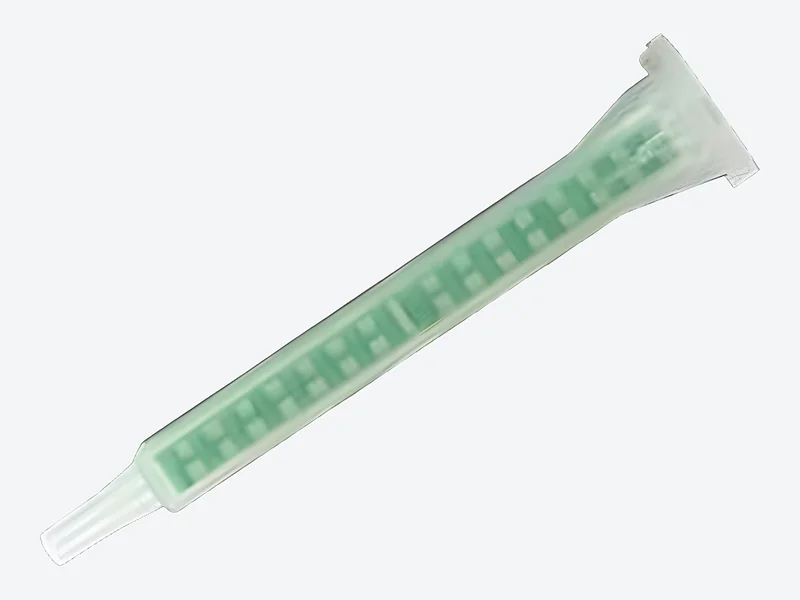
These bayonet static mixing tubes fit 50 ml A-system style cartridges and are sized for fine beads and dots of mixed epoxy, acrylic or polyurethane. The outlets are narrower than on our square bayonet tubes, at 1 or 1.5 mm.
Mixing cores come in 3, 5.4 and 6.3 mm, with 7, 12, 17 or 21 elements. The shortest tube is a 7-element stub at 33.6 mm (1.32 in.) overall and the longest runs to 154 mm (6.06 in.).
| SKU | Length mm | Length in | Elements | Hub / fitting |
|---|---|---|---|---|
| LS-DSP-006-3.0-7S | 33.6 | 1.313 | 7 | Bayonet |
| LS-DSP-006-3.0-17S | 62 | 2.438 | 17 | Bayonet |
| LS-DSP-006-6.3-12S | 98 | 3.875 | 12 | Bayonet |
| LS-DSP-006-5.4-17A | 105 | 4.125 | 17 | Bayonet |
| LS-DSP-006-5.4-17S | 106 | 4.188 | 17 | Bayonet |
| LS-DSP-006-6.3-21S | 154 | 6.063 | 21 | Bayonet |
No sizes in this family at the selected gauge. Ask us for a custom size.
Other element counts, lengths and outlets can be specified to order.
Questions about bayonet static mixing tubes, 7 to 21 elements
What outlet size should we pick?
Match the outlet to the bead or dot you need. The 1 mm outlet comes on the 3 mm core tubes and the 1.5 mm outlet on the 5.4 and 6.3 mm cores.
Is a 7-element mixer enough?
For some materials and at 1:1, it can be. Thicker or higher-ratio materials generally need more elements, so test the short tube against a longer one on your material before switching.
What goes wrong if the mixer is too short?
Unmixed streaks of resin or hardener leave the outlet and the bead cures unevenly or stays soft. If you see streaks, step up to a higher element count.
B-system mixers
2 families, 6 variants
MB Series Static Mixing Tubes
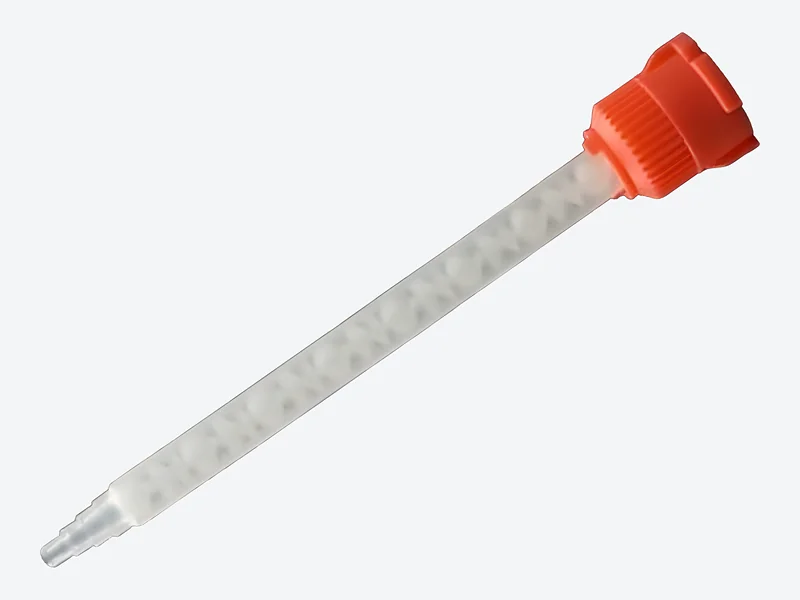
MB series mixing tubes fit B-system style 50 ml cartridges, which keep the resin and hardener outlets apart until the material enters the mixer. Distributor literature credits that design with removing cross contamination and plugged cartridges.
We list two 1:1 sizes, both with a 1.5 mm outlet. The 16-element tube has a 5.4 mm core, a 7.15 mm body and is 111.4 mm (4.39 in.) long. The 20-element tube has a 6 mm core, an 8.35 mm body and is 155.4 mm (6.12 in.) long.
| SKU | Length mm | Length in | OD mm | Elements | Hub / fitting |
|---|---|---|---|---|---|
| LS-DSP-007-5.4-16S | 111.4 | 4.375 | 7.15 | 16 | B system |
| LS-DSP-007-06-20S | 155.4 | 6.125 | 8.35 | 20 | B system |
No sizes in this family at the selected gauge. Ask us for a custom size.
Other element counts, lengths and outlets can be specified to order.
Questions about mb series static mixing tubes
Can we use these for 4:1 or 10:1 cartridges?
The two sizes we list are 1:1. High ratios need a mixer shaped to center the thin stream of catalyst, so ask us for a high-ratio version.
Why choose the 20-element tube over the 16?
More elements give the material more passes to blend, which helps with harder-to-mix materials. The trade-off is a longer tube and more material left in it.
Do the two sizes fit the same cartridge?
Both are made for the 50 ml B-system interface. Confirm your cartridge system before ordering, since B, F and K style outlets are not interchangeable.
Color-Coded MB Mixing Tubes
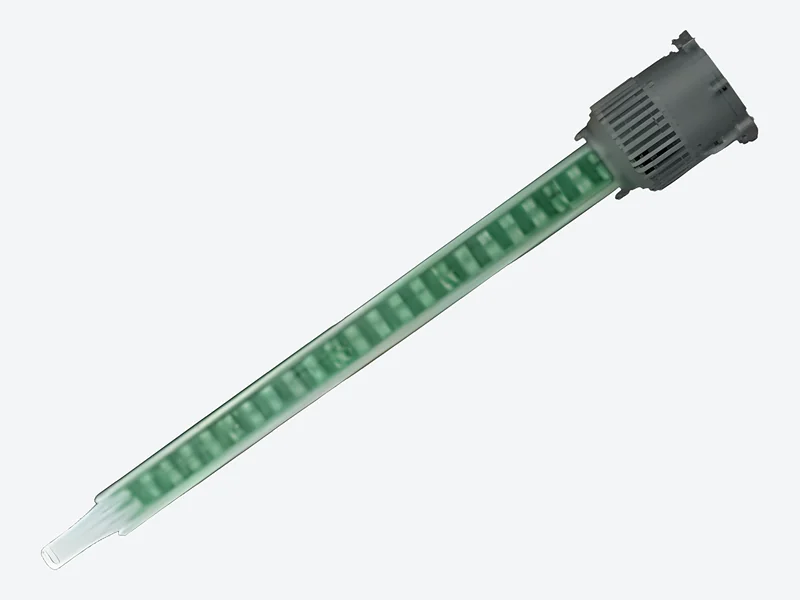
These short color-coded mixing tubes are for 1:1 two-part materials dispensed from B-system style cartridges. The body color identifies the size, so the right tube can be picked from the bin without measuring.
Four sizes make up the range. Yellow is 69 mm (2.72 in.) long with a 3.4 mm outlet. Red is 82.5 mm (3.25 in.) with a 5.0 mm outlet. Green is 89 mm (3.5 in.) with a 4.8 mm outlet. Purple is 91 mm (3.58 in.) with a 6.7 mm outlet. Body diameters run 5.8 to 9.7 mm.
| SKU | Length mm | Length in | OD mm | Our hub color |
|---|---|---|---|---|
| LS-DSP-010-Yellow | 69 | 2.72 | 5.8 | Yellow |
| LS-DSP-010-Red | 82.5 | 3.25 | 6.8 | Red |
| LS-DSP-010-Green | 89 | 3.5 | 8.1 | Green |
| LS-DSP-010-Purple | 91 | 3.563 | 9.7 | Purple |
No sizes in this family at the selected gauge. Ask us for a custom size.
Other element counts, lengths and outlets can be specified to order.
Questions about color-coded mb mixing tubes
Is the color code the same as other brands use?
No. Mixer colors are not standardized across suppliers, and some systems use color for caps or series rather than size. The colors here identify sizes in our range only.
Which size should we stock first?
Match the outlet to the flow your customers need. The yellow tube has the narrowest outlet and the purple the widest.
Are these for high-ratio materials?
All four sizes are listed at 1:1. For 4:1 or 10:1 materials, ask us for a high-ratio mixer.
C-system bell mixers
1 family, 6 variants
Bell-Mount Static Mixing Tubes
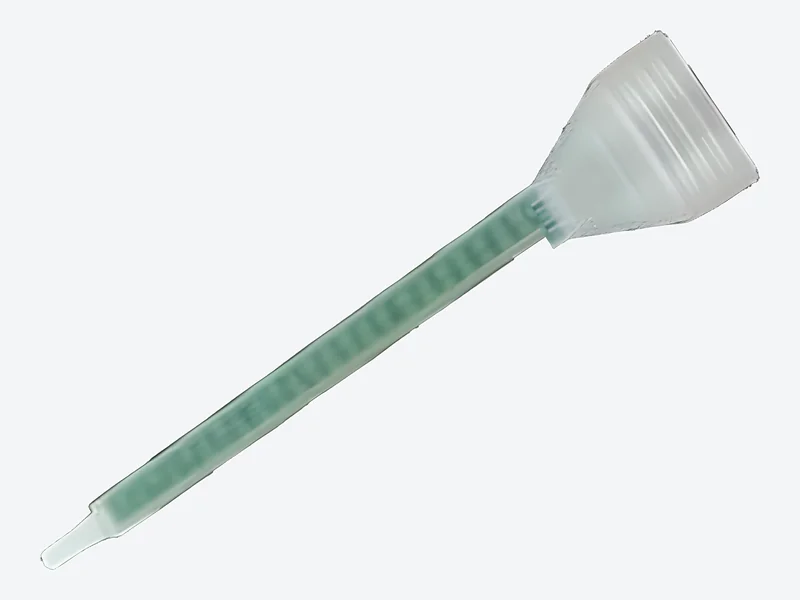
Bell-mount static mixing tubes connect to larger two-part cartridges and meter-mix equipment through a threaded bell inlet. Bell connections are the most widely shared interface across cartridge brands, which makes this the broadest-fitting mixer family we carry.
The range spans 4.8 to 17 mm body diameters, 3 to 13 mm mixing cores and 1 to 4 mm outlets, with 8, 16 or 24 elements. Lengths run from 38 mm (1.5 in.) to 293 mm (11.54 in.). Cores are white, yellow or green depending on size.
| SKU | Length mm | Length in | OD mm | Elements | Our hub color |
|---|---|---|---|---|---|
| LS-DSP-008-MC3.0-8s | 38 | 1-1/2 | 4.8 | 8 | White |
| LS-DSP-008-MFC6-16 | 96 | 3.78 | 7.5 | 16 | Green |
| LS-DSP-008-MC05-24 | 150 | 5.91 | 8 | 24 | White |
| LS-DSP-008-MC08-24 | 223 | 8.78 | 12 | 24 | - |
| LS-DSP-008-MC10-24 | 276 | 10.875 | 14 | 24 | - |
| LS-DSP-008-MC13-24 | 293 | 11.54 | 17 | 24 | Yellow |
No sizes in this family at the selected gauge. Ask us for a custom size.
Other element counts, lengths and outlets can be specified to order.
Questions about bell-mount static mixing tubes
Do bell-mount mixers fit other brands' cartridges?
Bell inlets generally fit the most common large cartridges and meter-mix equipment. Send us the cartridge or machine outlet size and we will confirm the match.
Does the core color tell us the mix ratio?
Not on its own. Across the industry, mixer colors mark series or cap combinations as often as ratio, so select by size, element count and ratio rather than color.
Do we need a shroud on a meter-mix machine?
At machine pressures a shroud stops the housing from swelling, which would let material bypass the elements. Ask us about shroud options for your tube size.
F-system mixers
1 family, 4 variants
F-System Static Mixing Tubes
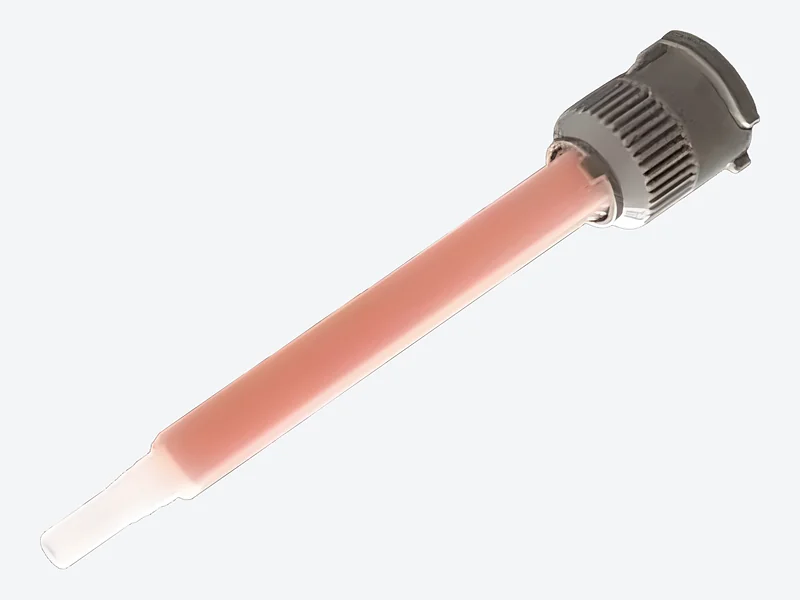
These static mixing tubes are for F-system style two-part cartridges, where resin and hardener leave through separated outlets and only meet inside the mixer. That layout is used to prevent cross contamination and curing at the cartridge tip.
Every tube in the range shares a 12.7 mm OD body, a 9.4 mm mixing core and a 3 mm outlet. Element counts of 12, 14, 16 and 20 give overall lengths from 145 mm (5.71 in.) to 217 mm (8.54 in.), so element count is the only choice to make.
| SKU | Length mm | Length in | OD mm | Elements |
|---|---|---|---|---|
| LS-DSP-005-GSM9-12 | 145 | 5.71 | 12.7 | 12 |
| LS-DSP-005-GSM9-14 | 163 | 6.438 | 12.7 | 14 |
| LS-DSP-005-GSM9-16 | 185 | 7.28 | 12.7 | 16 |
| LS-DSP-005-GSM9-20 | 217 | 8.54 | 12.7 | 20 |
No sizes in this family at the selected gauge. Ask us for a custom size.
Other element counts, lengths and outlets can be specified to order.
Questions about f-system static mixing tubes
Why do separated cartridge outlets matter?
When the two components stay apart until they reach the mixer, they cannot react at the cartridge nose. That keeps the outlet from curing shut between uses.
Does the mixer set the mix ratio?
No. On a cartridge system the ratio is set by the two cartridge cylinders, and the mixer only blends what it receives. Ratios of 4:1 and 10:1 usually need a mixer built to steer the minor component, so tell us your ratio before ordering.
How do we choose between 12 and 20 elements?
Harder-to-mix materials and higher ratios need more elements. Start with the shortest tube that gives a uniform color and cure in a test bead, since longer tubes waste more material.
Adapters and connectors
1 family, 6 variants
Mixing Tube Adapters and Connectors
These adapters and connectors join two-part cartridges, cylinders and mixing tubes that were not made to fit each other. They let one mixer style serve more than one cartridge system.
The range covers three AB cylinder adapters with hole spacings of 23.5, 35 and 35.5 mm and interface ODs from 6.88 to 7.3 mm. Two converter heads, one 1:1 and one 10:1, turn a 400 or 490 ml cylinder into a short double-hole mixing tube. A blue connector with a 4.5 mm square hole matches our bell-mount tubes. All are molded in PP or PE.
| SKU | Length mm | Length in | OD mm | Material | Our hub color |
|---|---|---|---|---|---|
| LS-DSP-011-JT228 | - | - | - | - | - |
| LS-DSP-011-JT229 | - | - | - | - | - |
| LS-DSP-011-JT511 | 9.7 | 3/8 | - | Plastic, PP or PE | Blue |
| LS-DSP-011-JT231 | 32.2 | 1.27 | 7.3 | Plastic, PP or PE | - |
| LS-DSP-011-JT233 | 41.5 | 1.625 | 6.88 | Plastic, PP or PE | Clear |
| LS-DSP-011-JT232 | 42 | 1.65 | 7 | Plastic, PP or PE | Clear |
No sizes in this family at the selected gauge. Ask us for a custom size.
Other element counts, lengths and outlets can be specified to order.
Questions about mixing tube adapters and connectors
Is there one adapter that fits every system?
No. Bell and threaded interfaces are broadly shared, but proprietary quick-connect systems need an adapter made for that system. Send us the hole spacing and interface OD and we will point you to the right part.
What is the difference between the 1:1 and 10:1 converter heads?
The ports are sized for the ratio. The 1:1 head has two ports of about 7.8 and 7.4 mm, while the 10:1 head pairs a port of about 9 mm with one of about 4.6 mm.
How do we measure an AB cylinder for an adapter?
Measure the center-to-center spacing of the two outlet holes and the outside diameter of the outlet interface. Those two numbers identify the adapter.